|
K9 Freestyle with Richard Curtis |
||||||||
| Home | Video clips | Diary | My dogs | News | Displays | Workshops | Shop | Contact |
|
Articles
Tips for
routines
Costumes have become an important part of the performance but there
are some factors that need to be taken into consideration when picking
your costume. Firstly it is important to say that this is after all a
dog sport also it is the dog that everyone should be looking at. The
handler is just there as a member of the team to show off the dogs
skills, a useful quote I once heard was that “ the handler is the
frame and the dog is the picture” this I think epitomises what the
sport is all about. So it is very important that the costume does not
over power the dog. When deciding on a costume it is always important
to take into consideration what colour your dog is. If you have a dark
dog then you want to be wearing lighter coloured trousers as otherwise
the dog will be lost when it
In the end the costume is only a very small part of what freestyle is about and my best advice to pupils is if in doubt calm the costume down as the judges would rather see a dog performing well with the handler than a outlandish costume but the dog doing nothing.
Handler movements are another thing that can just add the finishing
touches to a routine. These do not have to be big dramatic gestures
but simply a movement that might lend itself well the routine. Many
handlers that have done some obedience get stuck in the habit of
holding their hands in the heelwork position, so by just getting the
handler to relax their arms and move them I time with the music helps
greatly. Certain types of music will also give you an idea of handler
movements which will aid the routine appearance. For example if you
were doing a Sometimes handlers have natural movements or ways in which they carry themselves which can be picked up on when choosing a type of music. For instance a person who is very upright in there stance and precise in there movement might suit a tango or Latin track where this would fit better than having to be relaxed and bouncy in a country track.
Don’t forget that the audience can be a very powerful tool in your routine try and get them on your side and you can be halfway there!! How can you do this well you could involve the crowd by getting them to join in and clap to the beat of the music. Also you can put in moves that are crowd favourites like long reverses and up on the back. If you can do put in some cute moves like paw over face or distance paw wave these are almost certain to get an ahhhhh form the audience.
When you step into that ring you should know the routine like the back of your hand so that you can almost go on auto pilot and concentrate on the dog rather than what moves is coming up next. To achieve this you need to go out and perform it without the dog again and again plus do it at home by listening to the track and imagining what is happening. In a future article I will discuss the build up to the competition and what can be done to make it an easier process
This article appeared in one of the National Sunday Paper magazines
![]()
The importance
of puppy training
As
many of you are aware i have recently got a puppy called Pogo and it
brought home to me the importance of the early training that we need
to do with our dogs. In the past it was common that a dogs training
was left until it was six months old but with modern methods it has
been shown to be advantageous to start them much younger.
For
the prospective freestyle dog, early training is very important as we
can sow many of the seeds for moves in those early weeks. Take for
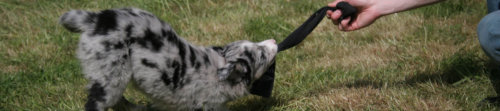
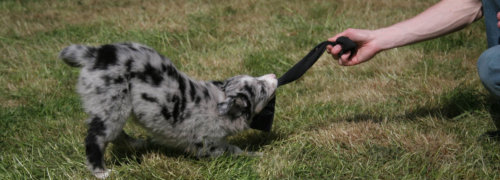
instance the walk back, when the puppy is tugging on a rope tug i walk
towards the pup who is pulling the rope backwards thus getting the
backwards movement i want. As the puppy does this, i can start to
place the command to it of "back" without the puppy really realising
that it has begun training. Play is very important and i know it is
harder to get some breeds to play then others but it is so important
you do, as i feel you get a different attitude from a dog that its toy
trained than one who works only for food.
Everything at this age should be fun fun fun for the puppy and lots of
play with various toys so that the puppy starts to realise that
anything that you have is the best thing on this earth. Try to use a
couple of toys in a session and don't always take the toy off the
puppy just let it drop the one it has when you produce a different
one.
Watching is the key move that we need to teach the puppy as if we can
start it at a very young age then the puppy will have a good grounding
before it steps into the outside world. Never let the pup get bored
always try to do a little amount but often in those early weeks.
Many other things we can get the small pup used to when we are
playing, just throwing the toy through your legs and letting the pup
chase it as some older dogs can be a bit worried about doing this.
Letting the pup follow the toy we can get it running around us and
weaving through the legs. Basically you can do anything with the pup
that is not going to put any stress onto the puppy's body so what i
call walking moves ie round, weave and through are great.
If
you are aiming for heelwork to music rather than freestyle then
teaching the puppy that the heelwork position is a lovely place to be
at this age is so much easier than trying to get a huge six month old
close to your leg. All my dogs learn the position of coming onto the
left leg by the time they are sixteen weeks.
A
lot of my training is done between 8 and 16 weeks as the puppy is like
a sponge at that age and so eager to take on new things. The most
important thing though is to keep everything fun and fresh and not get
too serious too soon.
Hints on
judging
Having judged widely since I started in the sport I often get asked by those that are just starting out judging if I can give them hints about where to start. At present there are a couple of systems that various clubs use, the one the I prefer is where each judge gives a score for all of the three sections.
Before you attend the show that you are judging at it is a good tip to sit down and watch past videos of competitions. This will allow you to formulate a "benchmark dog" for each of the divisions, this imaginary dog should reflect what in your mind is the ideal amount of content, accuracy and interpretation you require. Also if you are judging Heelwork to music you must have the ideal amount of heelwork in the various positions you require in the routine.
As the saying goes practice makes perfect and the more judging you do the more comfortable you will be with making decisions. I find that I tend to have a gut feeling about the marks a routine will generate now I have judged so many routines. I do find that I tend to have higher standards that I am looking for when judging a class perhaps than others, but its important that you do not just give high scores because of the class or because others are scoring high. It all comes back to that preparation of the "benchmark dog" for each class, if you have this then you should be ok.
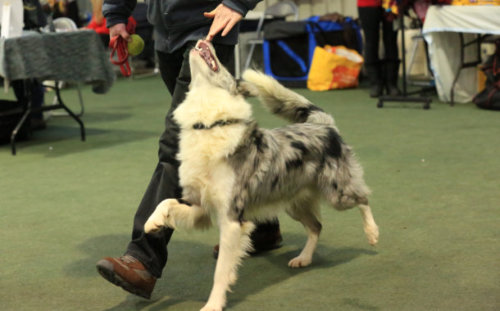
Jazz performing her Thriller routine in 2004
|
||||||||